The Economic Imperative of Sustainable Landscaping
The Egyptian real estate sector is undergoing a profound structural transformation. Driven by an expanding population that grows by nearly 2.5 million individuals annually, alongside rapid urban development in newly established megacities such as the New Administrative Capital (NAC) and New Alamein, the demand for high-quality commercial and residential developments is at a historic peak. In this highly competitive environment, real estate remains a primary safe haven against currency fluctuations and inflation, with average property prices per square meter in Greater Cairo rising between 12% and 18% in recent periods. Commercial real estate in Egypt currently yields impressive annual returns ranging from 10% to 15%, significantly outpacing more mature global markets.
However, sustaining these lucrative margins requires stringent control over facility management costs, particularly concerning exterior environments. Traditional landscaping in Egypt’s hyper-arid climate presents a severe financial and ecological burden. Natural grass surfaces utilized in commercial complexes, open stadiums, and public parks are highly susceptible to seasonal weather changes and require intensive daily agrotechnical maintenance, including continuous irrigation, chemical fertilization, dewatering, and damage renovation.
The financial viability of such maintenance is increasingly threatened by macroeconomic and regulatory shifts. The Egyptian government has signaled a transition toward liberalized water tariffs and the potential introduction of strict water consumption quotas for industrial and commercial entities by 2026, aimed at covering mounting infrastructure and maintenance costs. Furthermore, unpredictable construction material costs and high inflation rates complicate long-term facility budgeting. Consequently, sustainable landscaping—specifically the strategic deployment of artificial turf and advanced faux botanicals—has transitioned from a mere aesthetic alternative to a fundamental financial necessity.
High-quality artificial turf supports up to 50 hours of intensive use per week without the degradation experienced by natural grass, effectively eliminating irrigation costs, fertilizer dependency, and daily labor requirements. For developers, this translates to a predictable operational expenditure (OPEX) model, ensuring that the visual appeal of a property remains pristine year-round while safeguarding high rental yields and long-term asset valuations.
Navigating Green Building Certifications: LEED and GPRS
Beyond direct operational cost savings, sustainable landscaping plays a pivotal role in achieving international and regional green building certifications. Certifications such as Leadership in Energy and Environmental Design (LEED) and Egypt’s localized Green Pyramid Rating System (GPRS) are increasingly demanded by multinational tenants, institutional investors, and sovereign wealth funds as verifiable proof of environmental compliance and asset resilience.
LEED v4.1 Certification Strategies for Landscaping
Under the comprehensive LEED v4.1 framework, exterior landscaping decisions directly influence several critical credit categories, most notably the Outdoor Water Use Reduction prerequisite and credits. To achieve base certification, projects must demonstrate a minimum 20% reduction in aggregate water consumption from a calculated baseline.
The implementation of artificial landscaping provides a streamlined, highly effective pathway to maximizing these points. By utilizing high-quality synthetic turf and artificial botanicals, commercial projects can often pursue Option 1: No Irrigation Required. This option requires project teams to prove that the landscape demands no permanent irrigation system beyond a maximum two-year establishment period, thereby securing maximum points in this highly weighted category.
Furthermore, the integration of sustainable decorative pots and eco-friendly planters contributes directly to the Materials and Resources (MR) category. Planters manufactured from recycled materials, such as Linear Low-Density Polyethylene (LLDPE) derived from post-consumer waste, contribute to the Sourcing of Raw Materials credit. This aids projects in reaching the stringent 15% to 30% thresholds for recycled content by total material cost, a metric calculated through complex fractional budgeting during the procurement phase.
The Green Pyramid Rating System (GPRS)
Tailored specifically to mitigate Egypt’s unique environmental challenges—namely acute water scarcity, rapid desertification, and high energy demands—the GPRS places a heavier emphasis on regional resource conservation than its Western counterparts. Developed by the Egyptian Green Building Council (EGBC), the GPRS evaluates buildings across seven core categories.
Within the GPRS framework, Energy Efficiency (EE) and Water Efficiency (WE) are the highest prioritized categories, weighted at 21% and 19% respectively. Category 3 (Water Efficiency) allocates specific points for Water Efficient Landscaping (WE.02), which accounts for 2% of the total building weight. Utilizing zero-irrigation artificial landscapes ensures absolute compliance with these strict local benchmarks, directly mitigating the impact of Egypt’s growing water deficit, which currently stands at 13.5 Billion Cubic Meters annually.
Additionally, strategically placed planters and green structures on rooftops or elevated terraces can aid in Heat Island Reduction—a critical Sustainable Sites (SS) credit in both LEED and GPRS. By shielding dark, impermeable roofing materials from direct solar radiation, these installations lower the overall solar absorption of the building envelope, subsequently reducing the cooling load and HVAC energy consumption.
Specifying Eco-Friendly Planters for Commercial Success
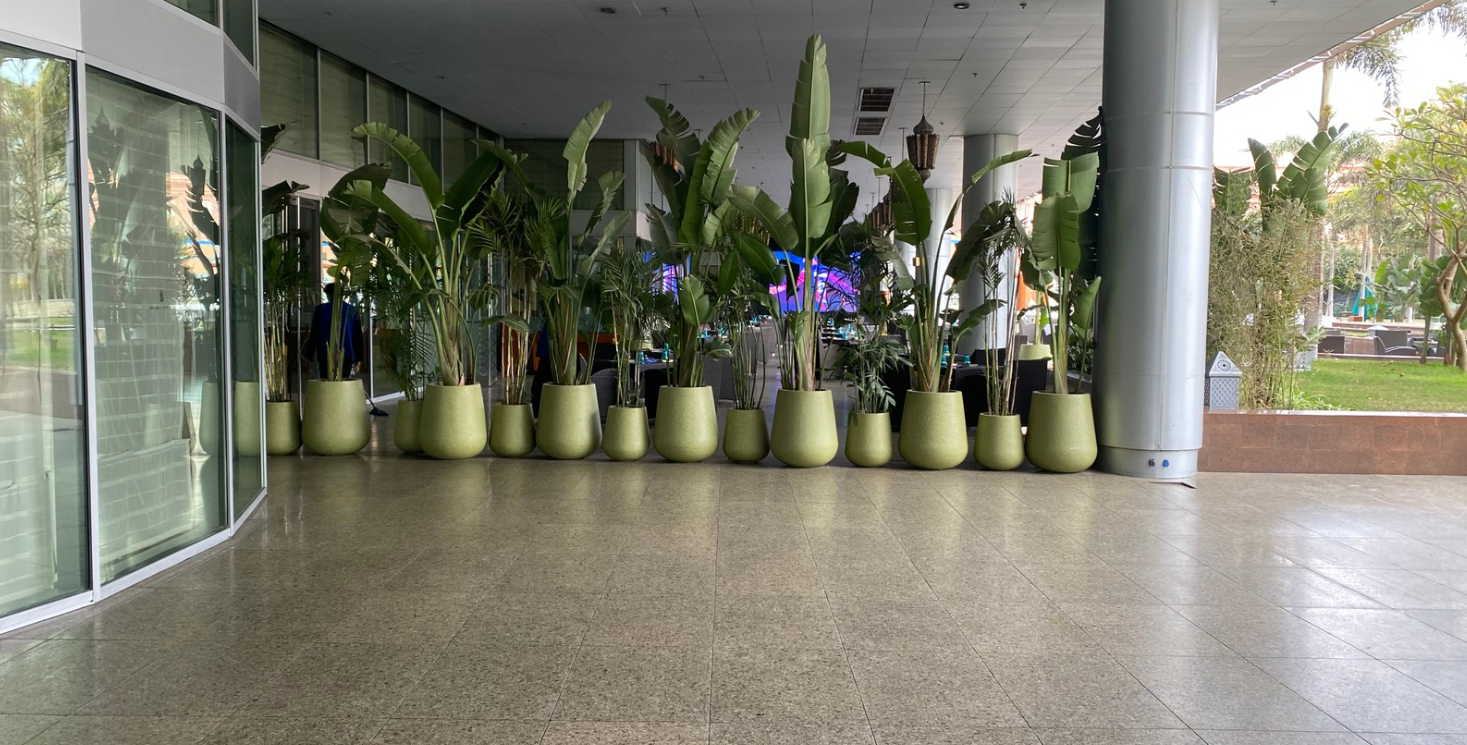
The integration of artificial botanicals must be supported by equally sustainable infrastructure. The technical specification of planters and decorative pots significantly impacts both the aesthetic longevity and the environmental footprint of a commercial megaproject.
| Planter Material | Lifecycle Characteristics | Environmental & Certification Impact |
| Recycled Resin (LLDPE) | Lasts 10–20 years; impact-resistant; withstands extreme thermal expansion and contraction without cracking. | Qualifies for LEED MR credits; can be recycled 7 to 9 times; redirects substantial waste from municipal landfills. |
| Marine-Grade Aluminum | 75% lighter than traditional cast concrete; absolute corrosion resistance in heavily polluted or coastal urban areas. | Infinitely recyclable without structural degradation; low structural load optimizes feasibility for extensive rooftop installations. |
| Fiberglass | High durability; exceptional strength-to-weight ratio allows for large-scale architectural designs. | Low-VOC emissions support LEED Indoor Environmental Quality (IEQ) credits; 10–20 year lifespan prevents rapid turnover. |
For property managers and urban developers, specifying these advanced materials mitigates the severe risk of premature structural failure caused by UV degradation or high-velocity wind zones, while simultaneously bolstering the project’s sustainability narrative and quantitative ESG (Environmental, Social, and Governance) reporting metrics.
Internal Linking Strategies
- Link “artificial turf” to the primary product category page detailing commercial-grade artificial grass specifications.
- Link “eco-friendly planters” to the specific product catalog featuring recycled resin, marine-grade aluminum, and fiberglass pots.
- Link “LEED v4.1 framework” to a dedicated institutional whitepaper or detailed guide on designing for green building certifications in the MENA region.
Frequently Asked Questions (FAQs)
Q: How does artificial turf impact the ROI of a commercial property in Egypt? A: Artificial turf eliminates the continuous, compounding costs of irrigation, chemical fertilization, and intensive daily labor. This drastic reduction in operating expenses (OPEX), combined with the high durability of the surface, accelerates the payback period and preserves the 10-15% ROI typical of Egyptian commercial real estate, insulating owners from future utility tariff hikes.
Q: Can artificial plants and sustainable planters help achieve LEED certification? A: Yes. High-quality artificial plants eliminate the need for outdoor irrigation, helping projects achieve maximum points for the LEED Outdoor Water Use Reduction credit. Furthermore, specifying planters manufactured from recycled materials contributes directly to the Materials and Resources credits by augmenting the project’s total recycled content value.
Q: Why is the GPRS framework particularly relevant to Egyptian real estate developers? A: The Green Pyramid Rating System is uniquely calibrated to Egypt’s specific climate challenges, heavily weighting water (19%) and energy efficiency (21%). Compliance with GPRS aligns with national sustainability goals and future-proofs commercial assets against impending government water consumption quotas and energy pricing restructurings.
Conclusion and Call to Action
The transition toward sustainable, zero-irrigation landscaping in Egypt has evolved from an ecological preference into a rigorous financial and regulatory strategy. By integrating advanced artificial landscapes and specifying highly durable, recycled planters, real estate developers can insulate their portfolios against resource scarcity, command higher property valuations, and effortlessly navigate the complex matrices of international green building standards.
Project stakeholders are encouraged to consult with specialized landscape strategists to specify premium artificial botanicals and eco-friendly planters engineered explicitly for the Egyptian climate. Integrating these sustainable solutions during the initial design phase ensures maximum aesthetic brilliance alongside robust, long-term sustainability credentials.